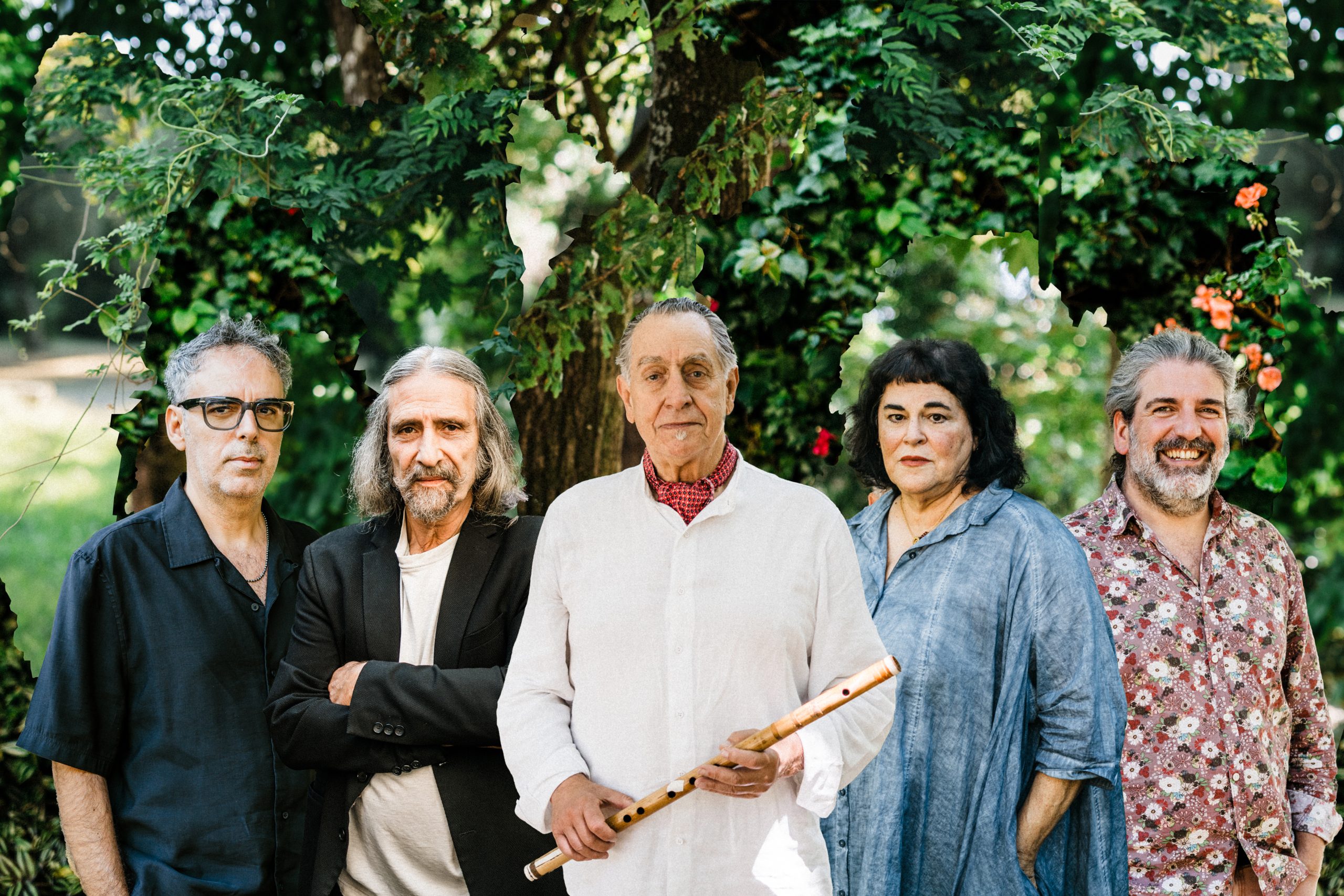
Seara is the apotheosis of the journey that has been taking shape at Roots Club. In this collaborative concert, Amélia Muge, Daniel Pereira Cristo, Júlio Pereira, Manuel de Oliveira and Rão Kyao come together on stage, accompanied by Miguel Veras and Quiné Teles.
We spoke with Ilídio Marques, curator of the Roots Club, about what we can expect from this unique performance, which takes to the stage of the Main Hall of Theatro Circo this Friday, 19 December at 9:30 pm. Buy your ticket here.
Braga 25: This is the last major gathering of the year for Roots Club, and it takes place on the stage of Theatro Circo. Where did the idea for this performance come from?
Ilídio Marques: This performance emerges as the final point of a sequence of commissioned concerts throughout the year, which sought to intersect and bring into dialogue new and old languages of traditional music, while also safeguarding the existing heritage. We crossed the contemporary universe of Ana Lua Caiano and Bandua—leading figures of new Portuguese music inspired by roots music; we challenged the polyphonic singing of Mulheres do Minho to engage in a classical dialogue with composition students from the Calouste Gulbenkian Conservatory of Music; and we strengthened the connection between two community-based projects, the Electronic Devices Orchestra and the intergenerational singing group Outra Voz. The performance Seara emerges as a mirror of the past reflecting towards the future of Portuguese traditional music. We look back and identify names that played a significant role in Portuguese traditional music, in its various branches, while also invoking their legacy. We wanted the final moment of the programme to be a major celebration of Roots Club, while at the same time managing to write a page in the history of Portuguese music.
B25: What motivated the choice of these artists?
Ilídio Marques: Our aim was to bring together a group of musicians that would, in some way, synthesise the different spectrums of roots music, while also bridging generations. But we wanted to go further: based on this foundation, we wanted these musicians to have already had connections with one another—past, recent, sporadic, or even somehow forgotten over time. We wanted paths that had crossed in the past to meet again, projecting new bridges towards the future of traditional music. In the end, this constellation, as I like to call it, came together very organically, and we were fortunate that it happened exactly as envisioned, bringing together on the same stage the unique talents of Amélia Muge, Rão Kyao, Júlio Pereira, Daniel Pereira Cristo and Manuel de Oliveira.
B25: What impact can a performance like Seara have, considering the growing importance of defending the space occupied by Portuguese traditional music?
Ilídio Marques: I honestly believe that this performance safeguards that space of defence while also challenging what may come next, based on the impact it can create in the memory and stimulation of current or future generations. In traditional music, during the first two decades after 25 April, it was very common to see large gatherings on stage of figures who would go on to become historical in Portuguese music. There was an almost cooperative spirit in music-making that disappeared over the decades and that we are trying to renew here. These gatherings reinforce attention to the educational role of music and art in transforming society, which is extremely important as a response to the fragile and individualistic moments we are living through today as social beings. For the legacy and impact to be greater, the path would be to challenge artistic cooperation on a considerable scale.
B25: What can audiences expect from the meeting of such important artists, with such different paths?
Ilídio Marques: The Roots Club programme has always stemmed from the idea of sharing, because we believe that through sharing—whether musical, gastronomic or in another field—dialogue and collective creation are fostered. Just as we will have on stage musicians with such close yet different paths, we believe that in the auditorium of Theatro Circo we will bring together audiences from different generations, united by the pleasure of music but also by the desire to witness something unprecedented. When such solid careers are brought together on stage, a natural willingness to share emerges from the artists towards the audience, turning the stage into the living room and vice versa. What arises from this connection is always so unexpected that it often leads to moments that were not planned. And it is precisely this element of unpredictability that I believe one can expect from a concert like this—one that will open chests in search of forgotten repertoire and work with memories to place them in chests that we will close and only reopen a long time from now.